LiteLLM’s Router is pitched as smart load balancing across your model deployments. I read it at v1.92.0-dev.1, commit 88e03e5, and the default is a coin flip. Out of the box it uses simple-shuffle: pick a random healthy deployment, weighted by rpm/tpm if you bothered to set weights, uniform otherwise. It is not latency-aware or load-aware unless you opt into a strategy that is. What it does give you for free is a retry → cooldown → fallback failure ladder. And where it earns “smart” — the usage/latency strategies — it earns it by metering every key, which is the exact thing a subscription proxy can’t do. Every claim below points at a line.
What is it, and where does it sit?
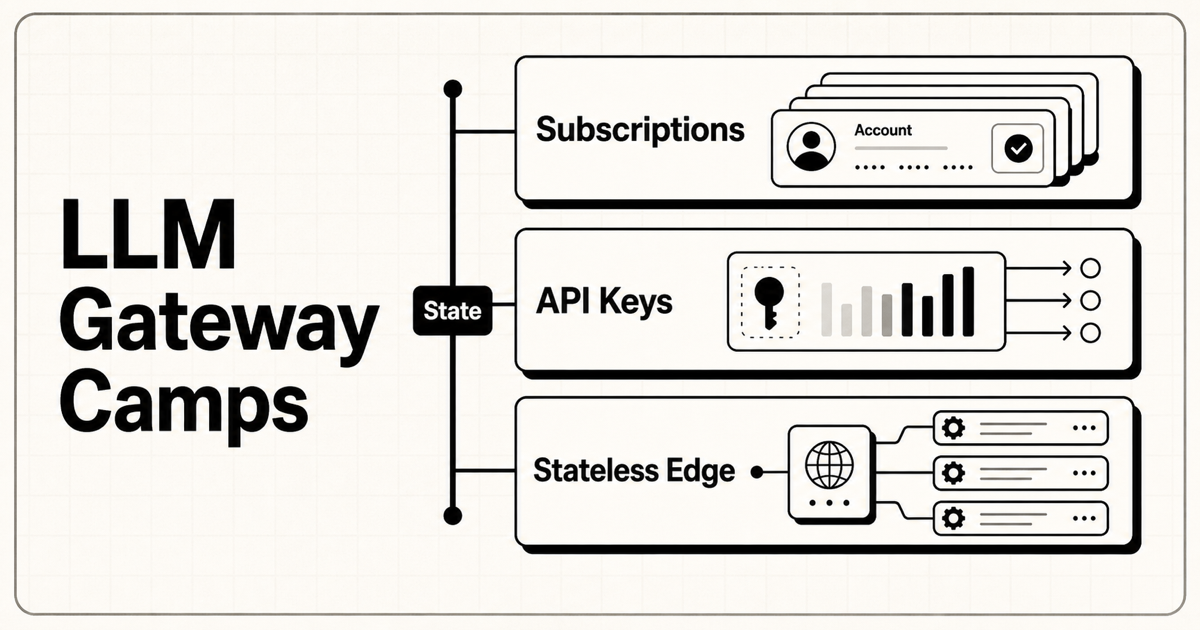
The Router is the thing that sits in front of a model group — several deployments (API keys, regions, or providers) that all serve, say, gpt-4 — and picks one per request, then handles failure. It’s the API-key routing half of the LLM-gateway comparison. The other half is the subscription-account proxy I tore down separately (CLIProxyAPI); the contrast at the end is the whole point.
The default is dumber than the marketing
The default routing strategy is literally the string "simple-shuffle" (router.py:302), and it’s dispatched inline, bypassing the selector machinery the smart strategies use (router.py:10299). Here’s the entire selection logic:
# weighted pick if a weight/rpm/tpm is set...
selected_index = random.choices(range(len(weights)), weights=weights)[0]
# ...otherwise a plain coin flip
item = random.choice(healthy_deployments)
That’s simple_shuffle.py:59 and :68. No latency, no queue depth, no live load feeds into it. “Healthy” just means the deployment survived a set of filters — it isn’t cooling down, isn’t admin-blocked, and (if you enabled pre-call checks) fits the context window and is under its RPM limit. So the honest one-liner: by default, LiteLLM spreads load by weighted random choice, not by measuring anything. If you want it to measure, you opt in.
The smart strategies are opt-in — and they meter
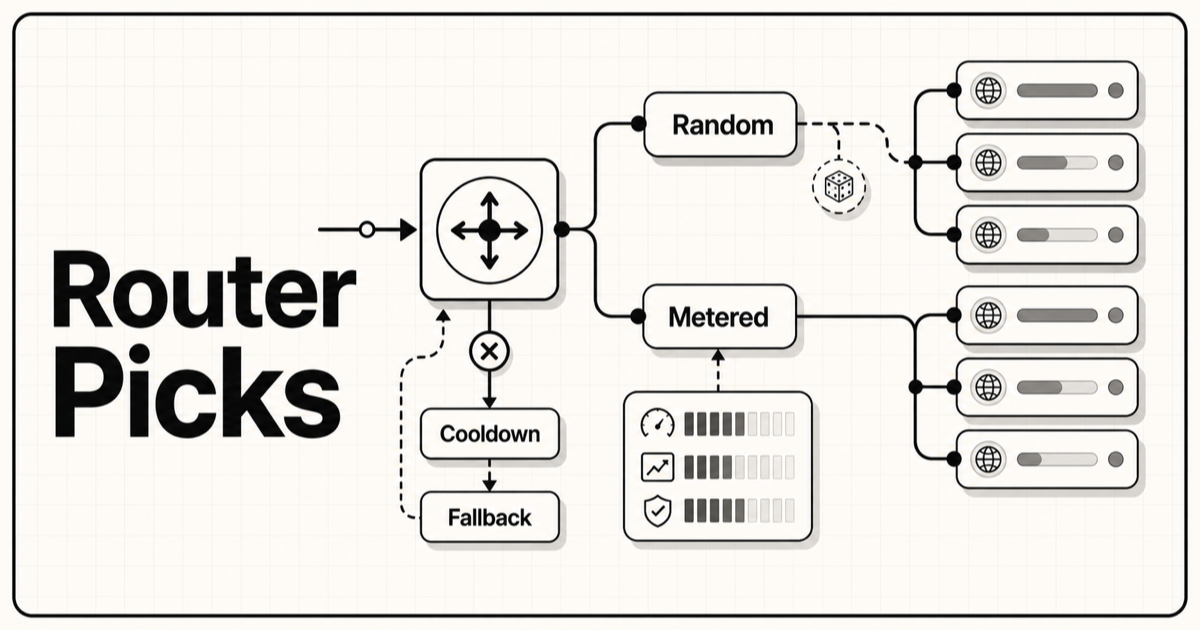
Set routing_strategy to one of least-busy, latency-based-routing, usage-based-routing[-v2], or cost-based-routing and a selector is built and registered as a logging callback (router.py:865). The trick that makes proactive routing possible is that each strategy writes a per-deployment metric on every call and reads it at selection time, into a DualCache (in-memory plus optional Redis) keyed by deployment id:
- least-busy keeps an in-flight request counter,
+1before the call and-1after (least_busy.py:44). - lowest-latency appends each response’s latency to a rolling per-deployment list and picks the fastest band.
- usage-based v2 increments per-minute
tpm/rpmcounters (lowest_tpm_rpm_v2.py:258) and, before dispatching, reserves an RPM slot with a pre-call increment that raisesRateLimitErrorif you’re over budget (lowest_tpm_rpm_v2.py:116, driven fromrouter.py:7120).
That reservation is the sharpest bit: with Redis, the meter is authoritative across proxy instances, so LiteLLM can refuse a request before it ever hits the provider.1 This is only possible because LiteLLM owns the key and sees every token spent through it.
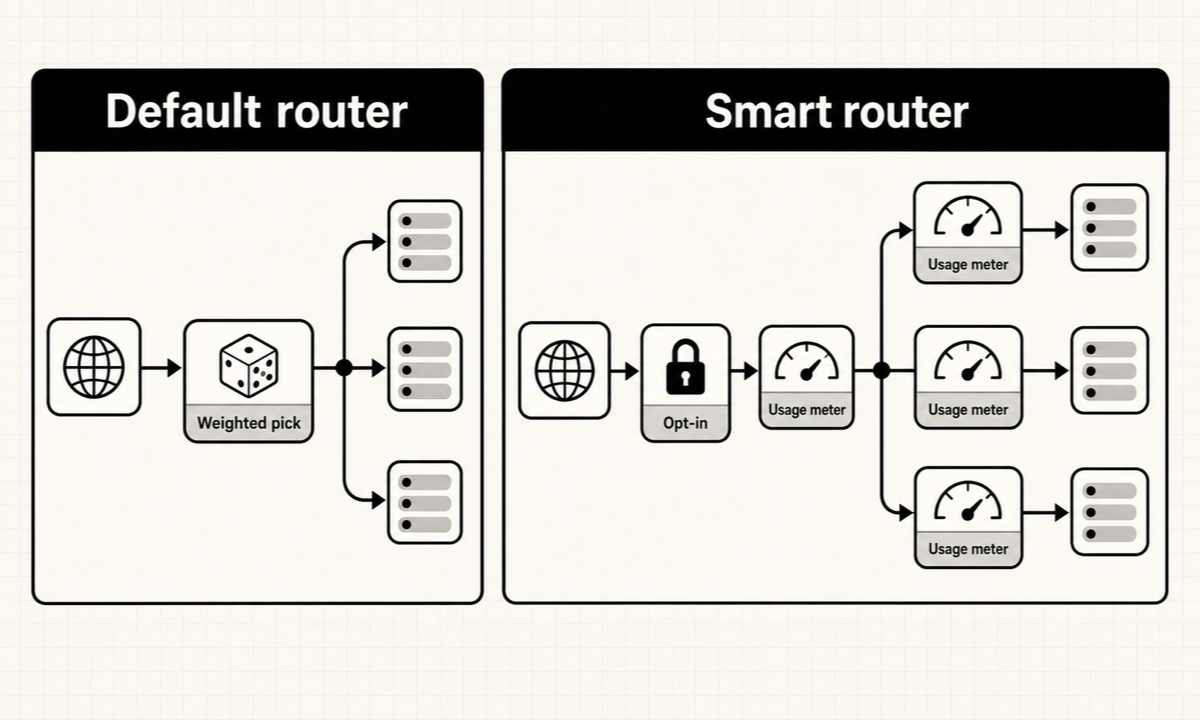
LiteLLM’s default router is weighted random over healthy deployments. The smart strategies become possible only when LiteLLM has per-key meters to read.
The failure ladder
When a call fails, three mechanisms fire in order. The defaults live in one file (constants.py):
| Step | What happens | Default |
|---|---|---|
| Retry | Re-pick a healthy deployment and try again | num_retries = 2 (:20) |
| Cooldown | Bench the failed deployment for a TTL | cooldown_time = 5s (:32) |
| Fallback | Cascade to a backup model group | ROUTER_MAX_FALLBACKS = 5 (:9) |
The ordering matters: it exhausts the 1 + num_retries attempts within the model group first, and only if those all fail does it move to a fallback group (router.py:6193). Two details worth knowing:
Retries are usually instant. The backoff function returns 0 — retry immediately — as long as the group isn’t down to a single deployment and has a healthy one left (router.py:6635). Because each retry re-picks and the just-failed deployment is being cooled down, “retry” effectively means “try a different one right now.” Only when you’re down to a lone deployment does it fall back to exponential backoff (0.5s doubling, capped at 8s, honoring a Retry-After header).
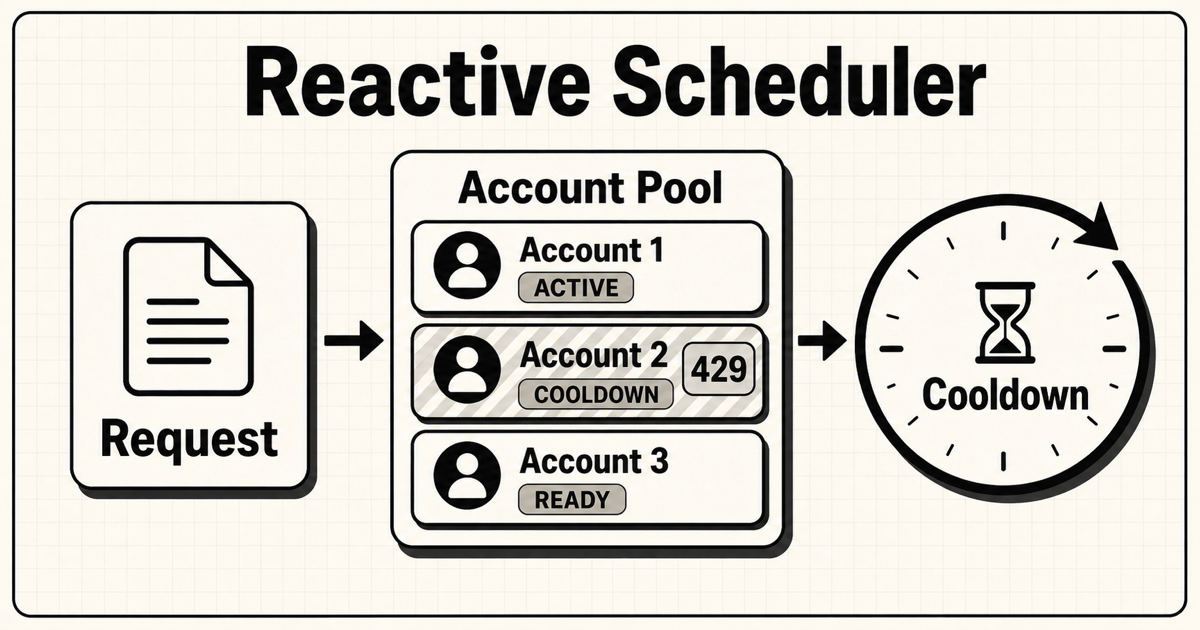
Cooldowns are short and rate-based — and spare your only model. A deployment is benched when it returns 429/401/408/404 or any 5xx (cooldown_handlers.py:40), or when its failure rate crosses 50% over at least 5 requests in the window (:210). But if the model group has only one deployment, the 429 and rate-based cooldowns are deliberately skipped (:204) — cooling down your only model would just make every request fail. The cooldown itself is a cache key with a 5-second TTL that expires on its own. Fallbacks then split by failure type: a context-window overflow routes to context_window_fallbacks, a content-policy block to content_policy_fallbacks, everything else to the generic fallbacks list.
Where does this fit?
Same axis I used for CLIProxyAPI: what are you routing, and can you see its cost?
LiteLLM routes API keys, and it meters them — every request updates that deployment’s tpm/rpm/latency/in-flight count. That visibility is what lets it (optionally) route by least-busy or usage or latency, and reserve capacity before spending it. CLIProxyAPI routes subscription logins bound by opaque quota windows it can’t see, so its only lever is reaction — wait for the 429, then cool the account down. Read side by side, the two are the same failover-cooldown skeleton with a crucial difference: LiteLLM can be proactive because it holds the meter; the subscription proxy can only be reactive because the meter is hidden from it. (And a small tell of that philosophy: LiteLLM refuses to cool down your only deployment; CLIProxyAPI benches individual accounts regardless.)
When would you reach for it?
Reach for LiteLLM’s router when you have multiple keys/deployments for the same model and want one endpoint with retries, cooldowns, and fallbacks that mostly Just Work. Go in knowing two things. First, the default doesn’t balance intelligently — if you care about load or latency, set routing_strategy explicitly and, ideally, wire up Redis so the meter is shared; otherwise set per-deployment weight/rpm so the random pick at least respects your capacity. Second, the failure defaults are aggressive-but-short: a 5-second cooldown and instant re-picks are great for transient blips, but they mean a deployment having a bad minute gets hammered again quickly — tune cooldown_time and allowed_fails if your providers are flaky.
Methodology & scope
I read LiteLLM v1.92.0-dev.1 at commit 88e03e5, focused on litellm/router.py, litellm/router_strategy/*, litellm/router_utils/cooldown_*.py and fallback_event_handlers.py, and litellm/constants.py. Three headline claims — the weighted-random default with opt-in smart strategies, the retry/cooldown/fallback ladder and its exact defaults, and the per-deployment metering that makes proactive routing possible — were each run through an adversarial claim-verifier at this commit and confirmed. Line numbers are exact there.
Scope caveats, stated plainly:
- I read the router’s routing and failure paths, not every one of the 15+ strategy files (there are newer adaptive/complexity/quality routers I did not open); the “smart is opt-in” claim is about the classic five.
- The RPM reservation is best-effort under a Redis outage — the code swallows connection errors and lets the call through rather than failing closed (
lowest_tpm_rpm_v2.py), so treat it as a strong reservation, not a hard guarantee. - A doc/code drift I’ll flag rather than paper over: the
cooldown_timedocstring atrouter.py:343says “Defaults to 1,” but the constant it actually resolves to is 5.
Footnotes
-
The atomicity is increment-then-check, so under heavy concurrency the reservation can transiently overshoot the limit between the increment and the check. It’s a real pre-call reservation, not a perfectly serialized lock — good enough to shed load, not a hard rate-limit guarantee. ↩