
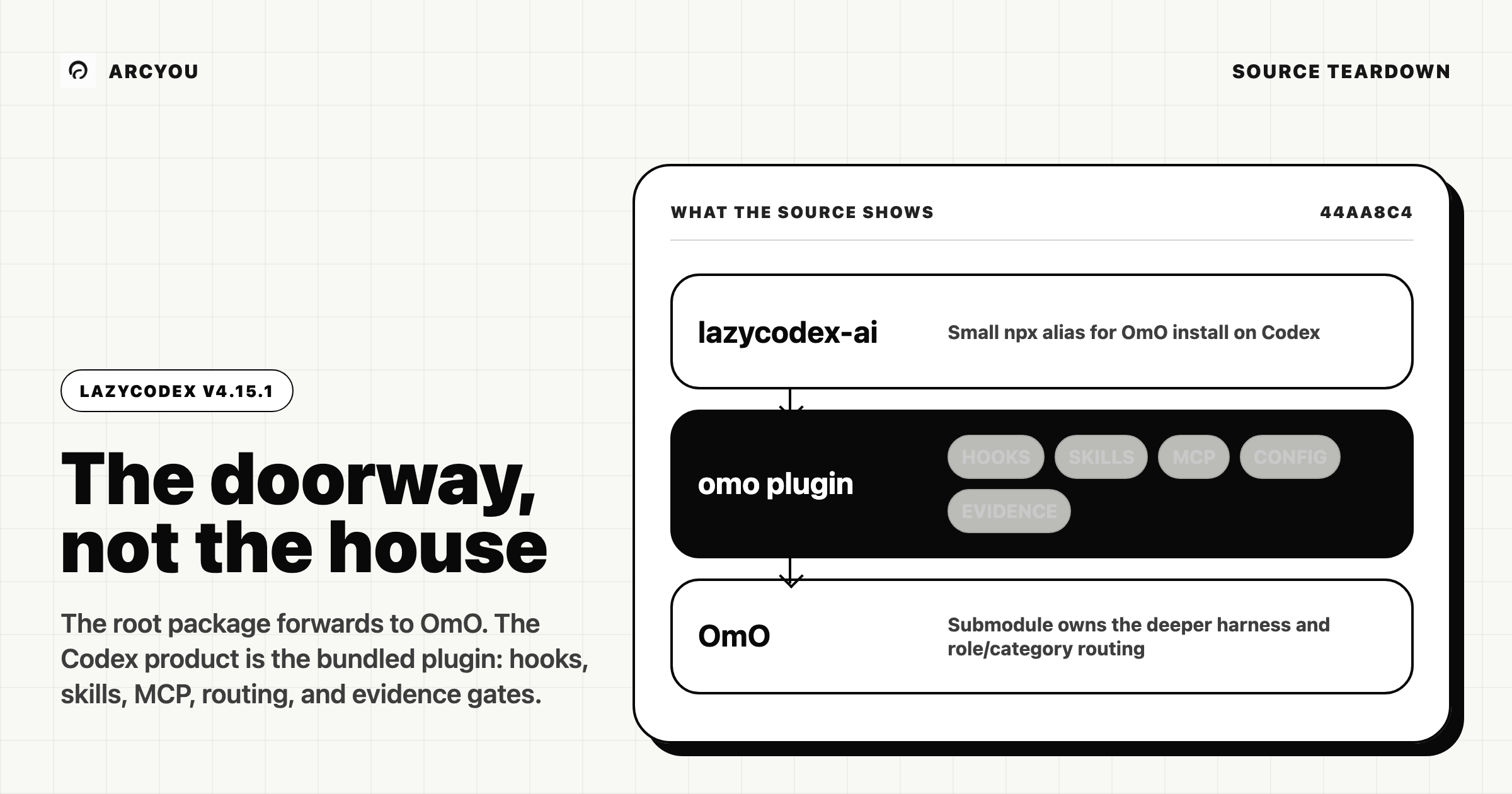
LazyCodex is marketed as an agent harness for complex codebases. I read it at v4.15.1, commit 44aa8c4, and the source says something narrower and more useful: the root package is a small Codex install alias, the concrete product is the bundled omo plugin, and the deeper harness ownership points back to OmO.
That is not a dismissal. It is the map you need if you are deciding whether to install it. LazyCodex is not a new model, and the root npm package is not where the harness lives. It is a doorway into a Codex-specific OmO setup: hooks, skills, MCP servers, model profiles, bootstrap logic, continuation, and evidence checks wired into Codex.
The shortest version
If you only remember one split, make it this one:
| Layer | What I found | Why it matters |
|---|---|---|
lazycodex-ai |
A small npm alias that forwards to oh-my-openagent |
The install command is convenient, but it is not the engine. |
plugins/omo |
The Codex plugin bundle: hooks, skills, MCP, config, bootstrap | This is the concrete Codex surface users actually get. |
src |
A submodule pointing at OmO | The deeper harness ownership sits outside the root package. |
The docs say this plainly once you get past the headline. The overview calls LazyCodex a light port of OmO into Codex, says it does not ship the full harness, and frames the useful piece as Hephaestus plus workflows (overview.md:1, :20-32). That is the honest version of the product.
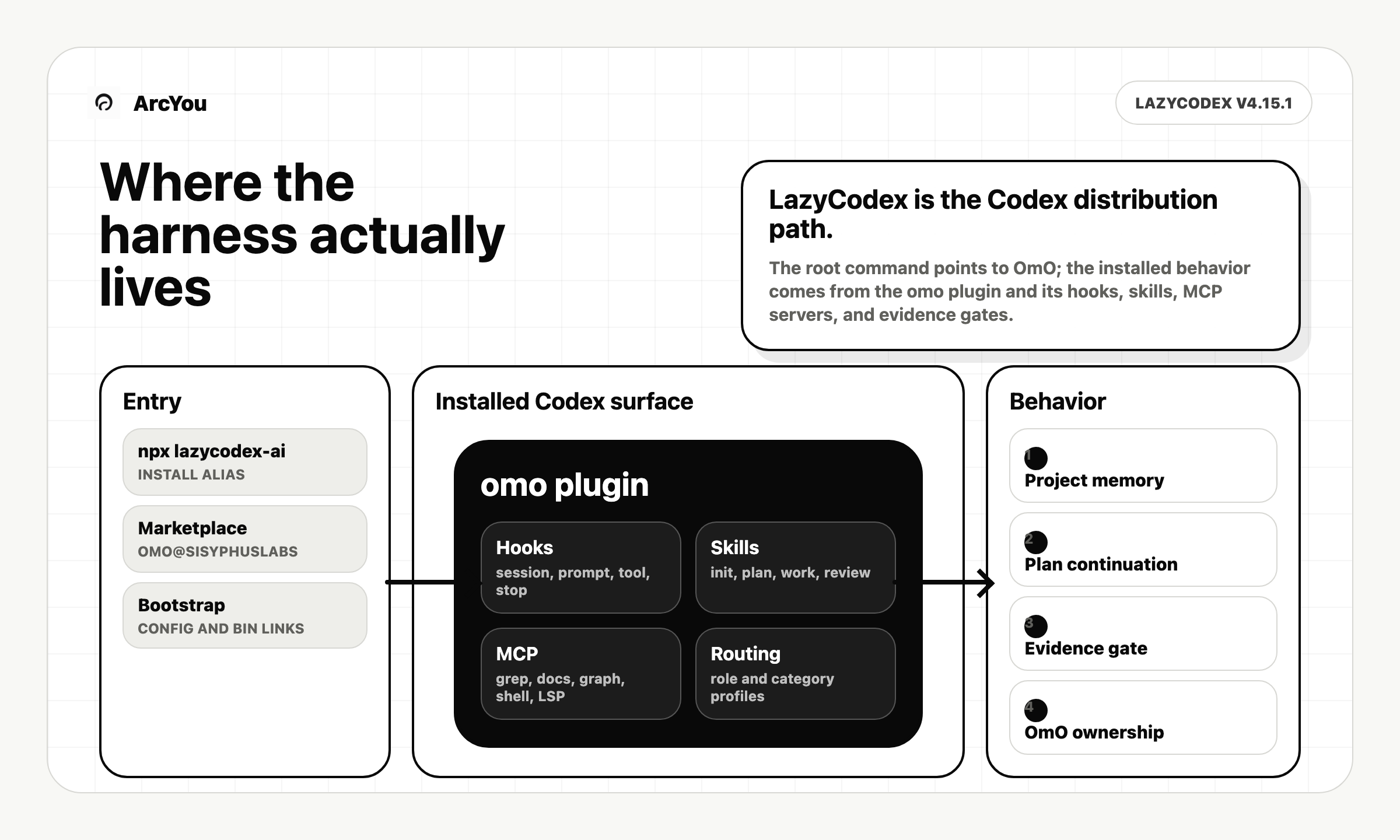
LazyCodex is easiest to understand as a three-layer stack: command alias, Codex plugin surface, and OmO ownership underneath.
Start at the command: it mostly forwards
The npm package tells you the first boundary. Its package.json names the package lazycodex-ai, describes it as a Codex install alias for oh-my-openagent, and exposes one binary: lazycodex-ai (package.json:1-8).
The binary is almost exactly what that description promises. If the first argument is install, it builds this command:
npx --yes --package oh-my-openagent omo install --platform=codex ...For any other command, it forwards to:
npx --yes --package oh-my-openagent omo ...That is not an inference from the README. It is the branch in bin/lazycodex-ai.js: install gets omo install --platform=codex, and non-install commands go to omo directly (lazycodex-ai.js:5-19). I also ran the root package tests locally; all 9 passed, including dry-run tests for install and non-install forwarding.
So the command is useful, but it is not where the interesting machinery is. It is a stable front door.
The ownership boundary is OmO
The next clue is .gitmodules: the src path points to https://github.com/code-yeongyu/oh-my-openagent.git (.gitmodules:1-3). I initialized that submodule while reading this post; at this LazyCodex tag it resolves to OmO commit 65715d1.
The README’s architecture section matches that layout: LazyCodex is described as a thin distribution layer, and OmO is named as the core engine included under src/ (README.md:247-260). The installation section says the one-line LazyCodex command is shorthand for an OmO install targeting the Codex platform (README.md:41-53).
That gives the right reading: LazyCodex is packaging, not authorship of every mechanism it exposes. It takes OmO behavior and makes a Codex distribution out of it.
The real Codex surface is plugins/omo
Once you stop looking for a giant runtime under the root package, the repo gets easier to read. The main Codex-facing surface is plugins/omo.
The plugin manifest declares the plugin name omo, version 4.15.1, a skills directory, a list of hook files, and a .mcp.json server config (plugin.json:1-45). Its interface metadata says the plugin exposes local Codex components such as Rules, Comment Checker, Git Bash, LSP, Ultrawork, ulw-loop, start-work continuation, and telemetry under one namespace (:46-69).
The MCP config is small and concrete: grep_app, context7, codegraph, git_bash, and lsp (.mcp.json:1-34). Locally, I counted 24 installed skill entries under plugins/omo/skills/*/SKILL.md and 21 hook JSON files under plugins/omo/hooks.
That is the product surface. Not one magical agent, but a bundle of Codex behaviors:
| Surface | Examples in the repo |
|---|---|
| Skills | init-deep, ulw-plan, start-work, ulw-loop, review-work, rules, lsp, ast-grep, visual-qa |
| Hooks | Session start, prompt submit, pre-tool, post-tool, stop, subagent stop, post-compact |
| MCP | Search, docs, codegraph, shell guidance, LSP diagnostics |
| Config | Model catalog, Codex config migration, subagent limits, hook trust restamping |
| Bootstrap | Runtime provisioning, agent role linking, component bin links |
This is why I would not evaluate LazyCodex by asking, “Where is the one agent loop?” I would ask, “What does this plugin add to Codex’s operating environment?”
The lifecycle hooks are doing real work
The docs describe hooks as the way the harness keeps long work moving without another user prompt (hooks-lifecycle.md:1-12). The implementation backs that up in a few places.
The start-work-continuation hook reads continuation state, and if there is active work left, it returns a JSON block decision instead of letting the turn end normally (codex-hook.ts:6-16). Its reader looks for .omo/boulder.json, finds work tied to the current Codex session, resolves the plan path, parses top-level checkboxes, and returns the remaining count (boulder-reader.ts:43-63).
The directive it injects is not subtle. It tells the agent it is mid-flight, not to ask whether to continue, and to pick the first unchecked top-level checkbox (directive.md:1-27). That is the harness idea in code: durable local state drives another turn.
The evidence check is similarly concrete. The lazycodex-executor-verify subagent stop hook only stays quiet when a lazycodex-executor reports a valid EVIDENCE_RECORDED path, and that path has to resolve inside .omo/evidence as a real non-empty file (codex-hook.ts:11-30, :52-64). If not, it blocks and asks for verification. The directive is blunt: a completion claim before recorded evidence is treated as false (directive.md:1-11).
That does not prove every workflow is perfect. It does prove the “verified completion” claim is not only copy. Some of it is enforced through Codex lifecycle hooks.
Bootstrap is the bridge between marketplace install and working setup
The marketplace path would be weak if it only dropped files into a plugin cache. LazyCodex has a bootstrap component for the gap between “plugin installed” and “Codex environment wired.”
The bootstrap hook is a SessionStart hook (hooks.json:1-16). On session start, it checks PLUGIN_ROOT and PLUGIN_DATA, reads the plugin version, skips if the version is already completed, and otherwise spawns a detached worker. The user-visible notice is exactly the one described in the docs: restart after the background bootstrap completes (hook.ts:40-76).
The worker setup sequence explains what gets wired: Git Bash preflight on Windows, bundled agent TOML linking, config blocks and hook trust restamping, git_bash MCP environment, and version-aware bin links (setup.ts:43-58). It stages bundled agent roles under plugin data before linking them into Codex’s agents directory (:85-134). It updates Codex config while explicitly not writing permission keys; autonomous permissions stay tied to installer flags (:136-169).
That last detail matters. The repo is trying to keep marketplace install additive and trusted by approval, while the more aggressive autonomous setup remains an explicit npx install choice.
Model routing is part of the harness, but do not overfit the model names
LazyCodex talks a lot about model routing. Here the strongest claim is structural, not about any one model name lasting forever.
The README points readers into OmO’s category and model requirement files (README.md:207-245). In the OmO submodule at commit 65715d1, openai-categories.ts defines categories such as ultrabrain, deep, and quick, each with different model config and prompt behavior (openai-categories.ts:127-147). The category requirements file gives fallback chains for work categories like ultrabrain, deep, and quick (category-model-requirements.ts:21-61). The agent requirements file gives separate chains for roles such as hephaestus, oracle, librarian, and explore (agent-model-requirements.ts:32-85).
The installed plugin also carries a model-catalog.json; the local profile I read is 2026-06-04.gpt-5.5-400k-reviewer-high, with a default high-reasoning profile and a stronger plan-mode profile. I would not make the article about gpt-5.5 as a permanent fact. The durable fact is that LazyCodex/OmO treats planning, execution, verification, and quick work as different routing targets.
So what should a builder conclude?
Use LazyCodex if you want Codex to become more opinionated: project rules loaded automatically, workflows exposed as skills, lifecycle hooks watching long-running work, MCP tools wired in, model roles configured, and evidence gates nudging agents away from empty completion claims.
Do not evaluate it as a standalone agent runtime. The root package is intentionally thin. The full harness story belongs to OmO. LazyCodex is the Codex distribution path that packages a focused slice of that world - especially Hephaestus-style deep work and the workflows around it - into a repeatable install.
That makes the name pretty accurate if you read it like LazyVim: not the editor, not the whole plugin ecosystem, but a distribution that decides how the pieces should be arranged.
Methodology & scope
I read LazyCodex v4.15.1 at commit 44aa8c4 and initialized its src submodule at OmO commit 65715d1. I focused on the root npm package, bin/lazycodex-ai.js, .gitmodules, README/docs, plugins/omo manifest and MCP config, lifecycle components, bootstrap code, model routing files, and local tests.
Local verification:
cd resources/repositories/lazycodex-v4.15.1
npm test
Result: 9 tests passed, including dry-run tests that confirm lazycodex-ai install forwards through oh-my-openagent with the Codex platform default.
Scope caveats:
- I did not benchmark runtime behavior inside a live Codex install. This article is a source-level teardown of what the repo wires and enforces.
- I did not claim LazyCodex ships the full OmO harness; the docs overview says the opposite.
- Model names can age quickly. The stable mechanism is role/category routing and fallback chains, not any single model label.